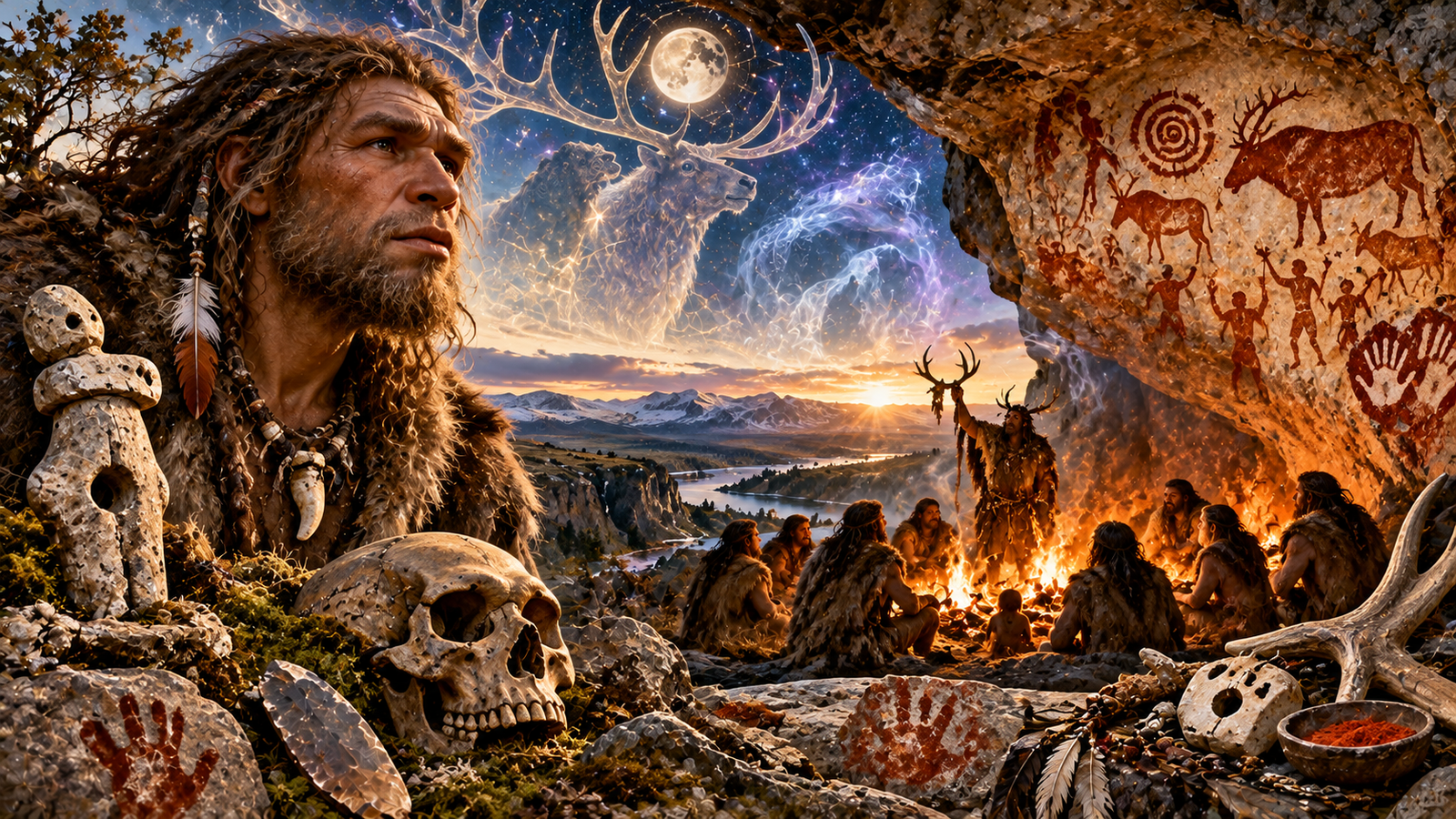
Neanderthal And the Evolution Of Religion
“Inventors, Discovers, or Myth.”
By Thomas M. Baurley
“Human Evolution”
Florida State University
Spring 1994
“Did Hom Sapien neanderthalensis invent religion?” Many scholars believe that the Neanderthals were the first practitioners of ritual, magic, and religion. But were they really? The controversy is difficult to explore and debate because religion is such a complicated issue. In fact, religion itself is often blanketed in controversy on whether it is real or not, does its elements exist, or are they just figures of our imaginations.
The first key in approaching an answer to these perplexing quandaries is to come to a base definition of what religion, ritual, and magic is. No two scholars, anthropologists, religionists, or people will completely agree with a sing, final definition since religion is very much mis-understood, mysterious, and individualistic. For simplicity of this study I will use a definition that most anthropologists will agree with, that is “religion is the human networks or collections of ideas, attitudes, acts, social patterns, and/or other symbols expressing the nature of transcendant reality and what humans are in relation to it, and intended to draw power from that reality and that relation.” (Ellwood 1983) Religion to some is seen as a form or force of dominance.
It can also be agreed upon that those who practice religion, also perform some sort of religious or magical rite and/or ritual. For these purposes a rite is “an observance, commonly religious, done is a set, determined way” and a ritual is “the pattern of words and/or actions through which a rite is carried out; or any ordered sequence of events, actions, and/or directed thoughts, especially one that is repeated in the “same” manner each time, that is designed to produce a predictable altered state of consciousness within which certain magical or religious (artistic or scientific?) results may be obtained.” (Bonewits 1989)
Magic in religious studies is a “word generally used to mean producing desired results or controlling events by manipulating supernatural forces or beings through symbols such as charms, spells, and rituals thought to have an irresistible power over them. Magic differs from religion by working for particular limited ends rather than expressing the full nature of transcendent reality; it stresses power over the supernatural rather than the oneness with it or devotional service toward it; and it desires that power for particular goals rather than full salvation, liberation, or real selfhood.” (Ellwood 1983)
According to Durkheim, Religion consists of two fundamental categories – “beliefs and rites” or “states of opinion” and “determined modes of action.” (Durkheim 1961) As Durkheim puts it “Religion presupposes a classification of all the things, real and ideal of which men think, into two classes of opposed groups, generally designated by two distinct terms which are translated well enough by words profane and sacred, the division of the world into two domains, the one containing all that is sacred, the other – all that is profane, is the distinctive trait of religious thought.” (Durkheim, p. 52)
So where exactly does this evolutionary adaption of “religion” come from? Is it solely a human trait? The realists view of functional persuasion regard religion as being derived from or closely related to the material conditions of life and in that way see it as an important lubricant which aids the articulation of social and economic institutions with the environment. (Dickson quoting Gertz, pg. 6)
“By this system of symbols that will act as to establish powerful, pervasive and long lasting moods and motivations in our species by formulating conceptions of a general order of existence and by clothing these conceptions with such an aura of factuality that the moods and motivations seem uniquely realistic.” (Geertz 1973, pg. 90)
In studying Religion, most scholars will take the approach of either Malinowsky or Frazer. Malinowski sees religion as serving a practical purpose or function to every cultural pattern while Sir James Frazer assumes such practices and beliefs are arbitrary and irrational. These are known as the Malinowsky functionalism and the Frazerian absurdity perspectives in the analysis of religion. In view of Neanderthal religion, both extremes have ample evidence for their sides and debates.
In the study of religion, we know that throughout religious history, we have four basic types of religious institutions or experiences (or “cults” as Wallace uses). These are (1) Individualistic Cults, (2) Shamanistic Cults, (3) Communal Cults, and (4) Ecclesiastical Cults. Individualistic religion is the simplest and most basic, rituals and rites that are practiced by the individual rather than by specialists such as shamans, priests, or clergy. In Shamanistic religion, there is the presence of a part or full time religious practitioner (clergy, medicine-man, sorcerer) who, endowed (usually by birth, inspiration, trauma, illness, or specialized training) with a special power can intervene, work magic, perform rites/rituals, quite often for a fee, with the supernatural (or natural) forces on behalf of his/her clients or laity.
In Communal Cults, one would see an increase in group rituals, usually based on seasons or triggered by certain events, and usually by trained clergy or priest/esses, but are not usually found in small scale band societies. The fourth group are what we are all most familiar with, the Ecclesiastical Cults, which are the most complex forms of religion, usually requiring full time paid religious clergy. (Wallace 1966) This is the institution of religion that houses our churches, temples, lodges, and synagogues.
In the development of religion, especially with Homo Sapiens neanderthalensis, our concern would be primarily with individualistic cults and perhaps shamanistic cults. In studying the past there are certain domains and premises that we have to presume as true in order to move and progress in our study, keeping in mind that all science, especially in anthropology and archaeology, our hypotheses, theories, and laws are quite simply “supported educated guesses”. In history, archaeology, and anthropology, the only way to definitely prove and understand the domain is to be a part of that domain, be a creator of that domain, and be in the cultural /geographical / and environmental constraints of that domain, of which we can probably never achieve without a “time machine.”
At this point of my revision, what are your thoughts currently? input?
More coming soon!